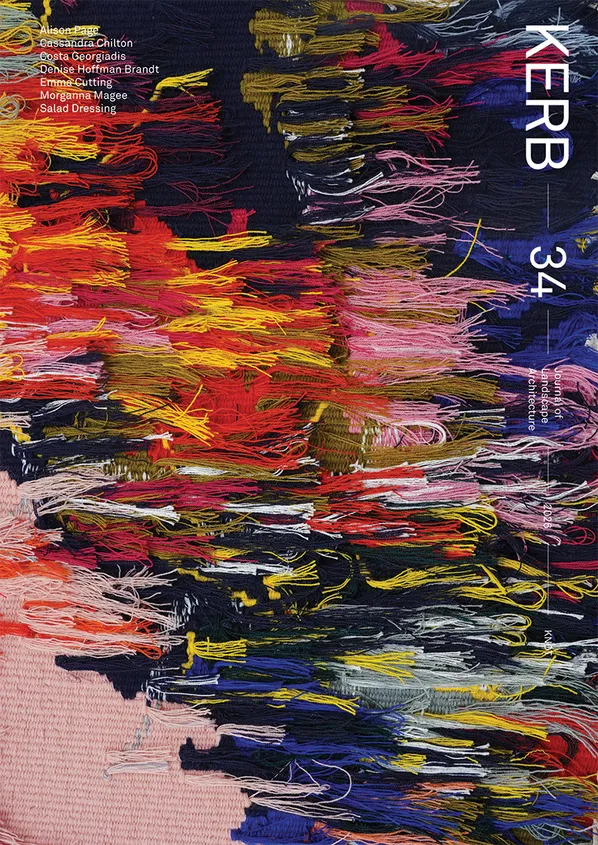
Kerb 34’s theme, KNOT, reflects the tangled nature of kinship.
Kinship describes the connections we inherit, form and pass along, that tie us to ancestral knowledges, one another and to the more-than-human world. In a moment of ecological instability and a shift in the technological paradigm, will these knots become stronger or will they unravel? Which connections should we maintain and pass forward, and which should we let go of?
We are graduating into a moment defined by overlapping environmental, technological and social transformations. We are practising on unceded Aboriginal Lands, situated within landscapes that are shaped by deep cultural histories, ongoing processes of colonisation, ecological vulnerability, climate change and rapid urban change. As emerging landscape architects, we are entering a profession where inherited systems are being questioned, or rather ignored, all while new responsibilities emerge. In many ways, we are all seeking clarity.
Instead, we find knots.
Throughout the production of the journal, we have worked with ‘the knot’ as a metaphor and a method—allowing us to trace visible and invisible relationships while revealing the tensions tangled within those connections.
Knot as metaphor
When we first selected KNOT as the theme for this year’s issue, we approached it as a metaphorical device—a way to think through the relationships that form landscapes. To think through knots is to think relationally and consider connection between people and place, history and future, the human and more-than-human worlds. It offers a language for exploring kinship as something uniquely formed through relationships, responsibilities and acts of care.
At the start of our editorial process, this metaphor helped us gather contributions that explore the changing nature of connection in the landscapes around us. As the issue developed, KNOT came to characterise the interlaced realities of relationships, obligations and practices across our landscapes and profession. Knots can hold conversations and communities together but also tighten systems. They can preserve memory while obscuring the past, and foster reciprocity while reinforcing distance.
As the issue developed, we realised KNOT was not only about connection. We initially imagined the theme as a way of exploring belonging, but contributors responded to our call-out by returning questions of responsibility, spiritual ways of being, noticing, and immersing oneself in their chosen landscapes. Discussions centred on relationships and more-than-human worlds were rarely presented as passive bonds or sources of comfort. Instead, they appeared as obligations requiring care, ongoing maintenance and widespread accountability. The contributions responding to our theme ultimately revealed the complexity, tension and uncertainty of kinship.
Knot as method
The process of editing this issue resembled the condition we were investigating; the journal itself became an exercise in knotting. Rather than arranging contributions into a unified narrative, we sought encounters and moments of pause between the different perspectives, scales and modes of practice in each contributor’s piece. As knots loosened, tightened and at times frayed, they materialised as sites of forgotten knowledge, unresolved responsibility and inheritance. Instead of solving these tensions, as editors, we chose to recognise that meaningful conversations often emerge from complexity rather than certainty.
Through this process, knot became a method of attention; a way of tracing the relationships that shape landscapes. It asks us to consider not only what connects us, but what responsibilities emerge from those connections—and what may need to be loosened, transformed, or undone.
How the journal is intended to be read
As editors, we have sought to communicate the nature of the knot. The journal’s structure reflects the knot as a metaphor, showing connections that cannot be neatly categorised. Conversation as a free forming entanglement has framed each chapter of knot. Contributions entangle discourse further, establishing a web of relations and prompting diverse ways of reading and understanding our knots.
We welcome readers to move freely between contributions, lingering where ambiguity or contradiction arises and embracing non-linear connections. Like the process of creating this issue, reading should mirror the entangled realities that sit at the heart of knot.
Origin fibres
Before any knot is tied, threads and fibres of memory, kinship, and ancestral knowledge must be carried through time. The landscape is understood by contributors as a living carrier of culture, ecology and relation. Alison Page blends First Nations knowledge, kinship, Country and design to explore how future cities and landscapes can pay attention to place and ecology. Carl Lorenz Cervantes’s ‘Living with the Duwende’ connects Philippine folklore with land, neighbourly relations and living alongside visible and unseen worlds.
Weft and warp
Everyday worlds are woven through crossings: between land and home, neighbour and stranger, ritual and responsibility, the seen and the unseen. These threads reveal how coexistence is shaped through care, obligation and attention to what lies beneath and around us. Costa Georgiadis entangles gardening and kinship within everyday acts of presence and responsibility, while Pratyay Raha extends this attunement into the shifting overlap of landscape and sonic ecology. These contributions frame the knot as a state of relation and close connection.
Tangles
Relations twist ecological, cultural, technological and sensory systems into forms that cannot be easily separated. What appears tangled becomes a way of understanding instability, intimacy and interdependence. The knot is now a radical form of relation. Contributors embrace the tensions that emerge from interdisciplinary practise and entangled processes. Salad Dressing discusses AI as a new species, while Denise Hoffman Brandt’s ‘Civil Defense Catalog—Water Wars Edition’ visualises water conflicts through an ouroboros, in an active acknowledgement of conflict, resistance and civil repair.
Mending
Repair is not forgetting what has been done, but the careful work of re-tying the forgotten or fractured relationships of what has been strained, broken, or violently pulled apart. Contributors acknowledge the grounding processes involved in repair and restoration through community activation. Jess Stewart describes the focus on care in her practice, while Emma Cutting discusses how the Melbourne Pollinator Corridor repairs connection.
The tapestry
From many loose threads, larger patterns begin to appear speculative, unfinished, strange and alive with possibility. Inherited taste, ecological anxiety, technology, culture, fantasy and design are woven into landscapes that imagine what might come next. Alistair Kirkpatrick promotes embodied plant knowledge, Cassandra Chilton’s ‘Modern Gardens for Unmanageable Futures’ draws AI imagery, kitsch suburban fantasy, machinery, wellness culture and ecological unease into garden worlds that feel both absurd and unsettlingly close to the present.
Casting off
Knot is not simply a celebration of connection, but an invitation to examine which ties deserve strengthening, which require transformation, and which may need to be released. Editing this issue reminded us that landscape architecture is shaped by complexity: ecological, cultural, political and technological forces that cannot be reduced to a single perspective or a simple solution.
Rather than seeking definitive answers, this issue records a moment of transition between study and practise, inherited knowledge and emerging technologies, established systems and uncertain futures. To embrace the knot is to acknowledge that landscapes are constituted through relationships that are dynamic, contested and constantly changing.
The question, then, is not how we untangle ourselves from the world but how we learn to inhabit our entanglements with greater awareness. How might we strengthen relationships grounded in reciprocity and care? How might we loosen those that perpetuate harm? How might landscape practice remain accountable to the many histories, ecologies, communities and futures with which it is bound?